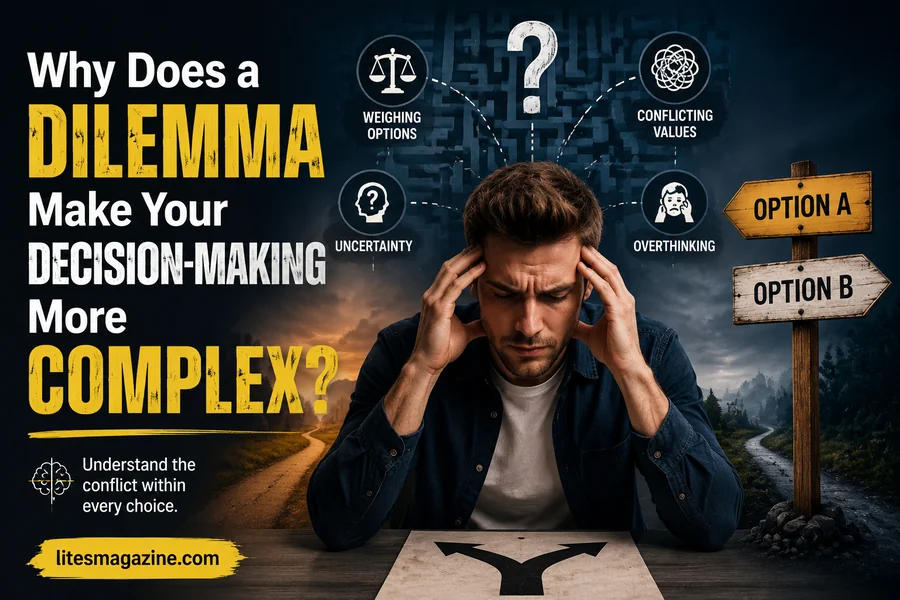
We all have to make a tough decision we can’t seem to figure out. You might have an idea of what you’re looking for, but another one might be the right one as well. There’s a dilemma there. If you have ever wondered, “why does a dilemma make your decision-making more complex?,” the answer is that the human brain can’t deal with the combination of dilemma, decision, risk, and emotion.
A dilemma refers to a scenario where one has to make decisions between options whose benefits and consequences differ. In doing so, one’s ability to reason is affected. It causes stress. One can even face uncertainty even after making their decision.
This article will explain why your dilemmas make reasoning difficult, how they affect your decision-making process, and why some people find themselves struggling more with dilemmas compared to others.
Why Does a Dilemma Make Your Decision-Making More Complex?
Why does a dilemma make your decision-making more complex? It is because it puts you in between options, all of which have value, risk or consequences of some sort. The brain needs to assess the consequences of your actions, anticipate what will happen, and prevent fear of a poor decision.
Dilemmas are more complicated decisions and they may include:
- Conflicting values
- Unclear outcomes
- Emotional pressure
- Social consequences
- Personal regret
This mix causes even minor decisions to be draining on the brain.
What Is a Dilemma?
A dilemma is a situation where you must choose between two or more options, but none feels clearly right.
A common example:
| Situation | Why It Becomes a Dilemma |
| Staying in a job or quitting | Security vs happiness |
| Telling the truth or protecting someone | Honesty vs relationships |
| Moving away for work | Career vs family |
The difficulty comes from trade-offs. You gain one thing and may lose another.
Why the Brain Struggles With Dilemmas
The human brain likes clarity. It prefers simple rewards and predictable outcomes. A dilemma removes both.
When options are equally important, the brain enters conflict mode.
Internal conflict increases stress
You may want two things that cannot happen together. That creates mental friction.
For example:
- You want financial stability
- You also want freedom
Choosing one may limit the other.
This tension makes your thoughts loop repeatedly.
Decision Fatigue Becomes Stronger
Decision fatigue happens when your brain uses too many energy processing options.
A dilemma increases this because you are not just choosing. You are analyzing possible futures.
You may ask:
- What if I regret this?
- What if this fails?
- What if the other option was better?
That repeated analysis drains focus.
Read Also: Why Are My Ears Ringing?
Signs of decision fatigue
- Overthinking
- Delaying action
- Anxiety
- Irritability
- Avoidance
The longer the dilemma lasts, the heavier it feels.
Emotions Make Decisions Harder
Logic matters, but emotions often guide decisions more than people realize.
A dilemma usually activates strong emotions such as:
- Fear
- Guilt
- Hope
- Attachment
- Shame
When emotions rise, reasoning often becomes slower.
You may know the practical choice but still avoid it because it hurts emotionally.
The Fear of Regret
One major reason why a dilemma makes your decision-making more complex is anticipated regret.
This means you imagine feeling bad before the decision even happens.
You start mentally rehearsing loss.
Examples:
- What if I leave and fail?
- What if I stay and waste years?
- What if I hurt someone?
This fear creates hesitation.
Regret can paralyze action
Many people stay stuck not because they lack options but because they fear future disappointment.
Too Many Variables Increase Complexity
Simple choices have clear outcomes. Dilemmas usually do not.
A dilemma may include:
| Variable | Example |
| Time | Is now the right moment? |
| Money | Can I afford the risk? |
| Relationships | Who will be affected? |
| Values | Does it match who I am? |
| Future goals | Will this help long-term? |
Your mind tries to solve all these at once.
That creates overload.
Cognitive Dissonance Plays a Role
Cognitive dissonance occurs when there is a conflict between two beliefs.
Cognitive dissonance is the pain experienced by people that have conflicting beliefs or values.
Example:
- You value loyalty
- You appreciate personal development also.
Whenever leaving a relationship helps you to grow, yet violates loyalty, your mind has a hard time reconciling both.
This brings about emotional unease and hesitation.
Dilemmas Trigger Overthinking
When it comes to challenging decisions, it is a universal experience that people overthink it.
The brain does not make a decision, it continues to gather more information.
This can seem like work, and it is frequently a procrastination tactic.
Common overthinking patterns
- Reliving dialogues
- Seeking absolute certainty
- Questioning lots of people
- Considering worst possible scenarios
- Second guessing at all times
It’s rare that perfection exists in dilemmas.
That is the reason why certainty may leave you paralyzed.
Social Pressure Makes It Worse
Some dilemmas affect only you. Others involve family, work, or social judgment.
When others are involved, decisions become more emotionally loaded.
You may think:
- What will they say?
- Will they judge me?
- Will this change relationships?
Social consequences can become heavier than the decision itself.
Why Some Dilemmas Feel Impossible
But not all dilemmas are experienced as equal.
Some concern identity.
What this means is that the choice determines one’s own identity.
Examples:
- Family over career ambitions
- Honesty over acceptance
- Peace over prestige
These are difficult choices since they affect fundamental beliefs.
It becomes intensely personal.
Your Past Experiences Shape Your Choice
Previous outcomes influence how you handle new dilemmas.
If past decisions led to pain, your brain may become cautious.
This is a learned protective response.
Example
Someone who took a risk and failed may avoid future change even when it makes sense.
Past disappointment changes confidence.
That makes new dilemmas feel larger.
The Role of Anxiety
Anxiety can intensify decision-making struggles.
People with anxiety often:
- Overestimate negative outcomes
- Fear uncertainty
- Delay final choices
- Seek repeated reassurance
A dilemma naturally contains uncertainty, so anxiety amplifies the stress.
Why Moral Dilemmas Feel Heavier
Moral dilemmas involve right and wrong.
These are often the hardest.
Examples:
| Moral Situation | Conflict |
| Telling a painful truth | Honesty vs protection |
| Reporting wrongdoing | Justice vs loyalty |
| Choosing self-interest | Need vs ethics |
Moral choices trigger stronger emotional responses because they affect self-image.

How the Brain Processes Dilemmas
Research in Psychology shows that decision-making involves both emotional and rational systems.
One part evaluates facts.
Another part evaluates feelings.
When these disagree, stress increases.
Simplified process
| Brain Response | Function |
| Logical analysis | Weighs outcomes |
| Emotional response | Predicts pain or reward |
| Memory recall | Compares past events |
| Stress response | Increases urgency |
This mix makes dilemmas feel mentally crowded.
Why People Delay Important Decisions
Delay is often not laziness.
It is a coping strategy.
When a dilemma feels overwhelming, avoiding it gives temporary relief.
But avoidance usually increases stress later.
Signs you are avoiding a dilemma
- Distracting yourself
- Postponing conversations
- Ignoring deadlines
- Hoping the problem disappears
This can create more pressure over time.
How to Make Dilemmas Easier to Handle
A dilemma may stay difficult, but it can become clearer.
1. Define the real conflict
Ask yourself:
What exactly am I choosing between?
Often the hidden issue is deeper than the visible choice.
2. Separate fear from facts
Write:
- What is real?
- What am I assuming?
This reduces emotional distortion.
3. Focus on values
Your best decision often aligns with your long-term values.
Ask:
What matters most to me in five years?
That question often reveals the right direction.
4. Accept no option may feel perfect
This is important.
Many dilemmas have no ideal answer.
You may only be choosing the option that aligns better with your priorities.
Can a Dilemma Be Good?
Yes.
A dilemma can create growth.
It forces deeper thinking.
It reveals priorities.
It teaches self-awareness.
Some of life’s most important decisions come from difficult dilemmas.
Without them, growth may stay limited.
Common Real-Life Dilemmas
Here are examples many people face:
| Type | Example |
| Career | Job security vs passion |
| Relationships | Staying vs leaving |
| Education | Study now vs work now |
| Family | Duty vs independence |
| Money | Save vs invest |
| Ethics | Truth vs protection |
These situations shape long-term outcomes.
That is why they feel significant.
Short Answers
| Question | Short Answer |
| Why does a dilemma make decisions more complex? | It creates competing choices with uncertain outcomes and emotional consequences. |
| Why are dilemmas stressful? | They force trade-offs and increase fear of regret. |
| How do dilemmas affect the brain? | They activate emotional and logical systems at once, causing conflict. |
| Can dilemmas improve judgment? | Yes. They can help clarify values and priorities. |
| Why do people avoid dilemmas? | To escape stress, uncertainty, and emotional discomfort. |
RelatedTerms
- complex decision-making
- difficult choices
- ethical dilemma
- personal conflict
- decision stress
- emotional decision process
- overthinking choices
- fear of regret
- internal conflict
- problem solving under pressure
Read Also: Why Are My Feet Swollen?
Final Thoughts
If you keep wondering why does a dilemma make your decision-making more complex?, the answer is simple but powerful.
A dilemma is a choice between options, and more than that. It is a matter of decision on the possible futures. All of them have gain, loss, emotion, and uncertainty.
This exercises the brain.
This stress is authentic because it is a real stake.
The blessing of this: bad decisions educate you on what is important. The problem might be awkward, but it can provide you with a newfound clarity.
Sometimes it isn’t the complexity that means that you’re weak.
This is an indicator that the decision is actually significant.
FAQs:
Why does a dilemma make your decision-making more complex?
A dilemma complicates decision-making because there will always be consequences to each choice, and one’s mind must consider risk, feelings & regret.
Why do dilemmas cause overthinking?
Dilemmas create uncertainty. That uncertainty makes people replay outcomes and fear making the wrong choice.
What happens in your brain during a dilemma?
Your brain processes logic, emotions, and past experiences at the same time, which slows decisions and increases stress.
Why do people avoid making difficult decisions?
Many people avoid difficult decisions because they fear regret, conflict, or disappointing others.
Can a dilemma improve decision-making skills?
Yes. A dilemma can help people understand priorities, values, and long-term goals more clearly.
Read More Articles: Why Does the Top of My Foot Hurt?