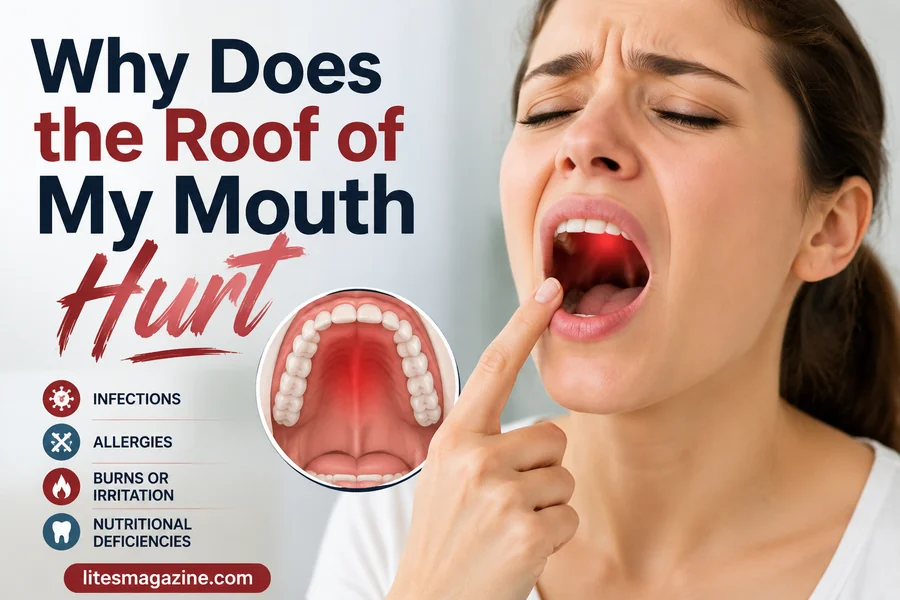
This morning you woke up and you didn’t feel right. Why does the roof of my mouth hurt — and you can’t figure out why. Perhaps it began after lunch yesterday. Perhaps it’s been bothering you for several days. In either case, it’s intrusive and you want answers.
The positive side is that most of the causes are not big. The bad news: Not all of these are. This article guides you through the probable reasons for this, what you can do, and when you should call a doctor.
Why does the roof of my mouth hurt? Start Here
If you have to draw a conclusion as to why does the roof of my mouth hurt, then consider the past 48 hours. Have you consumed any hot foods? Have a bite of a hard cracker? Feel a cold coming on? Your mouth is lined with thin, sensitive tissue that makes up the roof of your mouth (palate). Reacts quickly and takes a long time to heal. That’s why irritations, no matter how minor, can seem bigger than they are.
The hard front part is known as the hard palate. The soft part at the back is called the soft palate. The location of the pain is important to determining the cause.

The Most Likely Reasons Your Palate Is Sore
1. You Burned It
This is far and away the most common cause. Hot pizza. Boiling soup. That first sip of coffee you couldn’t wait on. The palate gets scorched easily and takes its time healing — usually 3 to 7 days.
It’ll feel raw and sensitive to anything acidic, salty, or textured. The fix is boring but it works: cool water, soft food, and patience.
2. A Canker Sore Has Formed
Canker sores are small ulcers — white or yellowish center, red edge around them. They show up on soft tissue inside the mouth, and the palate is a common spot. They’re not contagious. They’re just painful and inconvenient.
Stress is a big trigger. So are certain foods (citrus, tomatoes, chips), low iron, low B12, and hormonal changes. They usually disappear within 10 to 14 days on their own. Over-the-counter gels with benzocaine help take the edge off in the meantime.
3. An Infection — Viral or Bacterial
This one covers a few different scenarios.
Cold sores caused by the herpes simplex virus can appear on or near the palate. They blister, then burst, then crust. Strep throat inflames the soft palate along with the throat — so if swallowing hurts too, strep is worth testing for. Hand, foot, and mouth disease (mostly in kids but adults get it too) causes sores all over the mouth including the roof.
If you have a fever, swollen glands, or the pain is getting worse instead of better after 5 days, get it checked.
4. Dry Mouth
This one gets overlooked a lot. When your mouth isn’t producing enough saliva, the palate dries out and becomes sensitive — even cracked in some cases. Medications are a surprisingly common cause. So are mouth breathing, alcohol, and just not drinking enough water through the day.
Chewing sugar-free gum helps. So does a humidifier at night if you breathe through your mouth while sleeping.
5. Trauma From Food or Brushing
Crusty bread. Tortilla chips. Pita edges. These things are sharp and the roof of your mouth pays the price. Hard food can cut or scrape the palate and leave it sore for a couple of days. Brushing too aggressively near the palate does the same thing.
It heals on its own. A saltwater rinse speeds it up.
6. A Dental Problem Radiating Upward
The pain of a cracked tooth, dental abscess or infected gum can radiate in many different directions, including up into the palate. This should be considered if the soreness is concentrated around a particular tooth or one side of your mouth.
Don’t ignore dental infections. They spread.
7. Ill-Fitting Dentures
If you have dentures and the top of your mouth is sore, friction has most likely been the cause. The improperly fitting denture rubs constantly on the hard palate. That causes sores, redness and actual discomfort over time. The fit can be adjusted to the dental practice by your dentist.
8. Torus Palatinus (That Bony Lump in the Middle)
There is a bony ridge which runs in the middle of the hard palate for some people. It’s called a torus palatinus. It’s not a tumor. It’s not dangerous. Many people have it and are not aware of it until their dentist makes a discovery.
It only becomes a problem if it is continually disturbed by food or a dental appliance. Usually no treatment is needed. If it becomes a real problem, it can be easily extracted by a dentist.
Read Also: Why Are My Feet Swollen?
9. Acid Reflux
If the burning feeling in the roof of your mouth is associated with frequent acid reflux or acid in the throat, GERD could be the culprit. When stomach acid rises up the throat it can irritate or cause a burning sensation in the soft palate.
Eating well and not lying down immediately after a meal are a good place to start. If it does continue, a doctor can assist.
10. Oral Cancer — Rare, But Worth Knowing
If the sore or lump does not heal after 2-3 weeks, contact a professional. Full stop. Oral cancer may occur on the palate and it is much more treatable at an early stage. Tobacco, excessive drinking and HPV increase risk.
This is the only cause in which waiting around is not the right option.
Short Answer
| Question | Short Answer |
| Why does the roof of my mouth hurt when I eat? | Usually a burn or scratch being irritated by food contact — or a canker sore |
| Why does the roof of my mouth hurt near my teeth? | Likely a dental issue — abscess, decay, or gum infection spreading upward |
| Why does the roof of my mouth hurt when I swallow? | Points toward an infection — strep throat or inflamed soft palate |
| Why does the roof of my mouth hurt randomly for no reason? | Dry mouth, acid reflux, nerve irritation, or a canker sore forming |
| How long should this pain last? | Most minor causes clear in 3–14 days. Anything beyond 2 weeks needs a doctor |
| Can stress cause roof of mouth pain? | Yes — it’s a known trigger for canker sores and worsens dry mouth |
| Is a sore palate a sign of cancer? | Rarely — but a sore that doesn’t heal in 2–3 weeks should be evaluated |
| What’s that hard lump in the middle of my palate? | Almost certainly a torus palatinus — a harmless bony growth |
Match Your Symptom to a Cause
| What You’re Feeling | Most Likely Cause |
| Soreness right after hot food or drink | Thermal burn |
| Small white sore with a red ring | Canker sore |
| Blisters that burst and crust | Viral infection — cold sores or HFMD |
| Dry, tight, cracked feeling | Dry mouth or dehydration |
| Pain on one side near a tooth | Abscess or dental infection |
| Hard ridge in the center of the palate | Torus palatinus |
| Burning sensation + frequent heartburn | GERD or acid reflux |
| Sore present for more than 3 weeks | See a doctor — rule out serious causes |
Home Remedies That Actually Do Something
Simple care at home should alleviate most of the pain in the palate. Here’s what works:
Salt water rinse — ½ teaspoon of salt to 1 cup of warm water. Swish for 30 seconds, twice a day. It helps prevent swelling, and keeps the bacteria under control.
Cold foods — Ice water, plain yogurt, cold food. They soothe inflamed tissue, which would otherwise be worsened.
Honey — A teaspoon applied directly to a sore or burn can really make a difference by taking the sting out of the situation, and has a definite antibacterial effect.
Benzocaine gel — Over the counter as Orajel and other brands. Temporarily dulls the area and allows eating until healing occurs.
Aloe vera – Food grade gel, applied directly to the sore area is very effective for burns and canker sores.
Simply increase the amount of water you drink — Really. Dryness means something takes longer to heal and that it becomes sensitive to everything. It’s a dull patch, but it does count.
Foods to avoid: alcohol-based mouthwash, spicy foods, citrus juice, fizzy drinks and rough-textured food. They all tend to delay healing and make pain worse.
Read More: Why Does My Head Feel Heavy?
When to See a Doctor for Roof of Mouth Pain
Most palate pain clears up on its own within 7 to 14 days. But some signs mean it’s time to stop waiting.
See a Doctor or Dentist If You Have Any of These
Pain lasting more than 2 weeks This is the clearest rule. Minor burns, cuts, and canker sores heal within 14 days. If yours hasn’t moved — get it checked.
A sore or lump that won’t heal an unhealing sore on the palate is the top early warning sign of oral cancer. It may not even hurt much. That’s exactly why people miss it.
Fever alongside mouth pain Fever means your body is fighting an infection. Strep throat, a dental abscess, or hand foot and mouth disease can all cause this combination. Don’t manage it at home.
Pain near a tooth on one side One-sided palate pain near a tooth usually points to a dental abscess. These spread fast. See a dentist that day — not next week.
Difficulty swallowing When swallowing becomes painful or hard, the inflammation has gone deeper than surface level. This needs professional assessment.
Bleeding or numbness with no clear cause Spontaneous bleeding from the palate or unexplained numbness are symptoms doctors take seriously. Don’t explain them away.
Recurring sores — again and again One canker sore is normal. Four in six weeks is a pattern worth investigating. It could point to a nutritional deficiency or an autoimmune condition.
Doctor or Dentist — Which One?
| Symptom | See a… |
| Pain near a tooth or swollen gum | Dentist — urgently |
| Ill-fitting dentures causing sores | Dentist |
| Fever with mouth pain | Doctor |
| Sore not healing after 2–3 weeks | Doctor or dentist |
| Difficulty swallowing or breathing | Doctor — same day |
| Unexplained bleeding or numbness | Doctor |
| Recurring sores with no clear trigger | Doctor |
The One Rule to Remember
If the roof of your mouth has been hurting for more than 14 days with no improvement — see someone. That timeline is not negotiable.
One appointment rules out something serious. Waiting too long is the only mistake here.
When to Stop Waiting and See Someone
These are the indications that you need medical treatment:
- The pain has been there for more than 2 weeks and isn’t improving
- Have difficulty swallowing or breathing.
- A lump, swelling or sore that’s enlarging
- The sore doesn’t heal for no good reason.
- You have a fever, plus a painful mouth.
- You see swelling, pus or a tooth bothering you on both sides
- This repeats itself time and time again, there’s no apparent cause or reason.
All of these are not triggers for a panic. But they are all reasons to make an appointment and not wait!
Related Terms Worth Knowing
These questions appear in Google searches and medical discussions on this topic:
Palate pain — the general term for any discomfort on the roof of the mouth
Stomatitis — inflammation of the mouth lining, often behind unexplained palate soreness
Mucocele — a blocked salivary duct that forms a fluid-filled lump, sometimes on the soft palate
Burning mouth syndrome — a real condition where chronic burning occurs with no visible cause
Oral mucosa — the tissue that lines the inside of the mouth including the palate
Palatal torus / torus palatinus — the benign bony growth some people have on their hard palate
The Bottom Line
Why does the roof of my mouth hurt?
In most cases, it’s nothing serious. A burn heals. A canker sore is passed on. A scratch on a chip is gone after 2 days. Typically, simple home treatment is sufficient.
If it returns, or has been there for more than two weeks, however, don’t dismiss it. The condition of your mouth is an indicator to many about your health. When you feel something is wrong, it is always worth it to take a checkup with a dentist or doctor.
You now have a good starting point, as you know the most common causes of the roof of your mouth hurting, and how you can treat each cause.
Read Also: Why Are My Ears Ringing?
FAQs:
Q1: Why does the roof of my mouth hurt?
Thermal burn, canker sore, viral/bacterial infections, dry mouth, dental abscess, acid reflux, and sharp foods that damage the roof of your mouth can cause pain. Most cases are minor and do not require treatment and will resolve on their own in 3 – 14 days.
Q2: Why does the roof of my mouth hurt when I eat?
If you are experiencing pain while eating, there is a high likelihood that you have a burn, canker sore or a scratch caused by sharp food, which is causing pain. Worse: spicy, acid or fibrous foods. Eat only soft, cool foods and allow tissue to recover.
Q3: Why does the roof of my mouth hurt when I swallow?
If you have pain in swallowing, then the soft palate is inflamed. This occurs when someone has strep throat, tonsillitis or a virus, such as the flu. If eating gets hard to swallow or if a fever occurs, go to a doctor immediately.
Q4: Why does the roof of my mouth hurt randomly for no reason?
Dry mouth, acid reflux moving up the throat, early-stage canker sores and slight nerve irritation are common causes of random palate pain. If it continues without a definite reason then the dentist or doctor should have a look at it.
Q5: How long does roof of mouth pain usually last?
Most cases clear up in 3 to 14 days. Burns and small cuts heal fastest — usually within a week. Canker sores take up to two weeks. Any pain lasting longer than 2 to 3 weeks needs professional evaluation.
Q6: Can stress cause the roof of my mouth to hurt?
Yes. Stress is a well-known trigger for canker sores, which commonly form on the palate. It also worsens dry mouth and acid reflux — both of which cause palate irritation. Managing stress often reduces how frequently these flare up.
Read More Articles: Why Do I Keep Biting My Cheek?