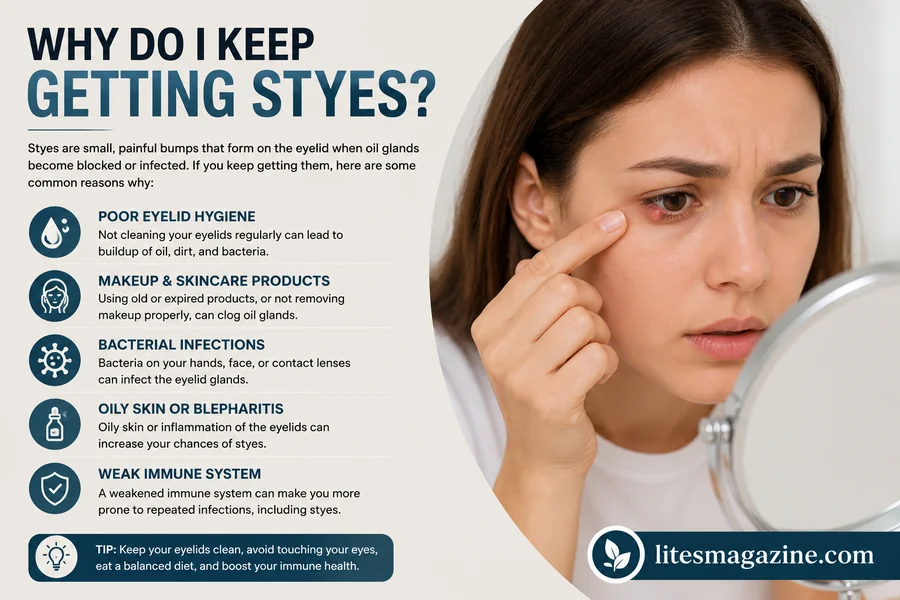
You’ve had one stye and moved on. Fine. But now it keeps coming back — same eyelid, same spot, same week of pain. So why do I keep getting styes when most people go their whole life barely dealing with one? There’s usually a real reason. And once you find it, the whole cycle stops feeling inevitable.
This article gets into the actual causes, what you can do about each one, and when it’s time to stop Googling and just see a doctor.
What Even Is a Stye?
A stye is a small infected bump on your eyelid — on the edge, inside, or just under your lash line. It forms when an oil gland or hair follicle gets blocked and then infected, usually by Staphylococcus aureus. That’s a common bacteria. It lives on most people’s skin without causing any trouble — until it finds the right conditions.
One stye is unlucky. Two or three? That’s a pattern. And patterns have causes.
Why Do I Keep Getting Styes? Here’s What’s Actually Going On
1. Your Eyelids Aren’t Being Cleaned
Not your face. Your eyelids — specifically that thin strip of skin right along your lash line. Most people scrub their face every day and never touch that area once.
Oil, dead skin, and bacteria collect there constantly. When that buildup sits long enough, the glands underneath get clogged. Clogged glands get infected. Styes follow.
It’s not a hygiene failure overall. It’s just a blind spot in most people’s routines — literally.
What to do: Warm damp cloth, 30 seconds per eye along the lash line, every morning. Or buy eyelid scrub wipes — they’re cheap and made exactly for this.
2. You Probably Have Blepharitis and Don’t Know It
Blepharitis is chronic eyelid inflammation. It’s common, it’s manageable, and a lot of people who keep getting styes have it without realizing.
The issue is that blepharitis creates an environment where bacteria multiply faster along your lash line than they normally would. It disrupts your oil glands. It makes stye-forming conditions almost permanent — unless you actively manage it.
| Signs of Blepharitis | What It Feels Like |
| Crusty eyelids when you wake up | Gritty sensation in your eyes |
| Red or swollen eyelid edges | Burning that comes and goes |
| Flaky skin near your lashes | Eyes that water without reason |
| Styes showing up repeatedly | General eyelid discomfort |
It doesn’t go away completely. But with a consistent eyelid hygiene routine, most people get it under control pretty quickly.
3. You Touch Your Eyes More Than You Think
Deficient intake of omega-3 can have a negative impact on the quality of the oil that is produced by your Meibomian Glands. Vitamin A and D deficiencies can cause dysfunction of the skin and immune system.
This isn’t to say that a salad is a cure for styes. However, if your diet really is lacking in these nutrients on a regular basis, your immune system and your glands will be operating at a sub-optimal level.
A good place to begin is oily fish, leafy greens, eggs and nuts.
4. Your Eye Makeup Is Older Than It Should Be
The shelf life of Mascara is 3 months. Most people use it for six months, a year, and at times more. At that time the bacteria had been carried hundreds of times by the wand into the tube. All successive applications are just wiping bacteria on the lash line.
Eyeliner and eyeshadow brushes are the same. They gather bacteria, skin cells and product waste — most people don’t clean them.
Some good habits that can make a difference:
- Change mascara every 3 months (more frequently if necessary)
- Wash your makeup brushes once a week or more often if necessary
- Avoid sharing any eye make-up.
- Remove everything before bed; sleeping with mascara will take a toll on your glands quicker than practically anything else
5. Your Meibomian Glands Aren’t Working Properly
Inside your eyelids there are tiny oil-producing glands called meibomian glands. They keep your eyes lubricated. When they malfunction — a condition called MGD, or meibomian gland dysfunction — the oil they produce thickens, the glands block up, and styes become a recurring problem.
MGD is closely connected to dry eye syndrome. A lot of people have both and don’t know either.
| MGD Symptom | How It Connects to Styes |
| Dry or irritated eyes daily | Blocked glands raise infection risk |
| Blurry vision that clears when you blink | Oil glands producing abnormal secretions |
| Foamy discharge along the lash line | Sign of gland dysfunction |
| Chronic eyelid inflammation | Direct cause of repeated styes |
An eye doctor can assess your meibomian glands in about five minutes. Treatment usually starts with warm compresses and lid massage — simple, but it actually works.
6. Stress Is Playing a Bigger Role Than You’d Expect
This one surprises people. But stress suppresses immune function — and a weaker immune response means your body is slower to fight off bacterial infections, including the ones behind styes.
There’s also the indirect side of it. When people are stressed, they sleep less, clean their face less consistently, and rub their eyes more. All three raise the chance of a stye forming.
If yours tend to show up during or just after a rough stretch at work or at home, that’s probably not a coincidence.
7. Hormones Affect Your Oil Glands
During puberty, pregnancy, or hormonal shifts tied to your cycle, oil gland activity increases and the chemical makeup of those secretions changes. This makes blockages more likely.
If your styes follow any kind of hormonal pattern — appearing around your period, for example, or during a time of hormonal change — it’s worth raising with your doctor. It won’t always be the cause, but it’s a real one.
8. What You’re Eating Might Matter Too
Phones. Keyboards. Door handles. Your face. People touch their eyes around 20 times per day without realizing. Each time that occurs, bacteria from your hands get on your eyelid glands.
When those glands are already somewhat blocked or inflamed (which relates to point one & two), that bacteria has everything it requires to cause a stye.
This is particularly a problem for contact lens wearers. Handling lenses involves repeated contact with the eye area for the majority of the day and numerous repeated contacts from hands that are not as clean as they can be.
Read Also: Why Are My Ears Ringing? Causes, Fixes, and When to See a Doctor
A Simple Daily Routine That Actually Helps
Nothing complicated here. What matters is doing it consistently.
In the morning:
- Wash hands before touching your face or eyes
- Warm compress on closed eyelids — 5 to 10 minutes
- Gently scrub your lash line with an eyelid cleanser or diluted baby shampoo
At night:
- Remove all eye makeup — fully, not halfway
- Warm compress if your eyelids feel irritated or heavy
- Don’t rub your eyes as you fall asleep
Each week:
- Wash your pillowcases — bacteria from your skin transfers to fabric every night
- Check your mascara and liner for expiry
- Wipe down your glasses frames, especially where they sit near your eyes
Short Answer
| Question | Short Answer |
| Why do I keep getting styes in the same eye? | That specific gland is likely prone to blockage — from anatomy, scarring from a previous stye, or localized bacteria buildup. |
| Can stress cause recurring styes? | Yes. Stress lowers immune function and increases habits like eye-rubbing that trigger styes. |
| Is it normal to get styes every few weeks? | No. That frequency points to an underlying issue — most commonly blepharitis, MGD, or contaminated makeup. |
| How do I stop getting styes permanently? | Consistent eyelid hygiene, clean makeup, managing blepharitis or MGD, and reducing eye-touching are the most effective long-term steps. |
| Can diet affect how often I get styes? | Yes. Low omega-3 and vitamin A can impair gland function and immune response. |
| Should I see a doctor for recurring styes? | Yes — if you’re getting more than 2 or 3 in a few months, get checked. There’s usually a treatable cause. |
| Are styes contagious? | The stye itself isn’t, but the bacteria behind it can spread through shared towels or makeup. |
| Can contact lenses cause styes? | Yes. Handling lenses introduces bacteria to the eye area and can irritate the glands that lead to styes. |
When to Stop Managing This at Home
Most styes resolve on their own in one to two weeks. But some situations need more than warm compresses.
See a doctor if:
- It hasn’t improved after two weeks
- The swelling is spreading past your eyelid
- You’re getting styes more than two or three times per year
- There’s eye pain, vision changes, or fever alongside the stye
- It keeps returning in exactly the same spot — this can occasionally signal a chalazion or, rarely, something more serious
A doctor may prescribe antibiotic drops, drain the stye in-office, or refer you to an ophthalmologist depending on what they find.
Read Also: Why Are My Feet Swollen? What It Really Means (And What You Can Do)
Final Words
So, why do i keep getting styes?
It’s usually one of these: eyelid hygiene issues, blepharitis, MGD, old makeup, or stress. Typically, a team of 2-3.
The most common error is considering each stye to be a random occurrence. It’s not random. There is a pattern — and patterns can be broken when you understand what makes them tick!
Get into the routine tonight: start simple! Wash lash line. Mix up the mascara that has been open since last year. Apply a warm compress in the morning. This does most of the cases by itself.
If not, then that is what doctors are for!
FAQs:
Q: Why do I keep getting styes?
Poor eyelid hygiene, blepharitis, meibomian gland dysfunction (MGD), or old and contaminated eye makeup are all common causes of recurrent styes. They can also be brought on periodically by stress and hormonal shifts.
Q: Why do I keep getting styes on the same eye?
It is probably due to a blockage or scarred gland in the area which is caused by a previous stye. Bacteria has a habit of getting trapped in the same location, particularly if hygiene of the eyelids around that area is not being maintained.
Q: How do I stop getting styes permanently?
Wash lash line every day, change mascara every 3 months, use warm compresses and see your doctor every day to be examined for blepharitis or MGD. If you treat the cause of the problem, your styes will not recur.
Q: Can stress cause recurring styes?
Yes. Stress reduces your body’s ability to resist infections with the bacteria that cause styes. It also leads to more rubbing of the eyes, poor sleep hygiene and hygiene.
Q: Is it normal to get styes frequently?
No. Getting more than 2–3 styes per year is not normal and usually points to an underlying issue like blepharitis, MGD, or contaminated makeup tools that needs to be addressed.
Q: Can old mascara cause styes?
Yes. Mascara tubes collect bacteria every time the wand is inserted. After 3 months, the bacteria load is high enough to infect eyelid glands on contact. Replace mascara every 3 months.
Q: What is blepharitis and can it cause styes?
Blepharitis is chronic eyelid inflammation that speeds up bacteria buildup along the lash line. It creates the exact conditions that lead to repeated styes and needs daily management.
Read More Articles: Why Does the Top of My Foot Hurt? Real Causes, Real Fixes