Most don’t think about it at all. You heat it, use it and you’re done. However, there comes a time when the question pops into your mind — why do they call it oven? It sounds ancient. Almost grunted. As the person who named it simply pointed towards the hot thing and uttered a word. They kind of did.
One of the words that have been around the English language for so long that no one asks anymore is “oven. However, once you begin to unravel the thread, the history of the thread is quite interesting to know. Not just because of the meme, but because something is said with it that says a lot about the actual nature of language.
Why Do They Call It Oven? Start With the Word Itself
It is from Old English — ofen. Originally, it was Proto-Germanic uhwnaz. It is from the same root that German derived their word Ofen and Dutch their word oven. Three different languages and three different words and all they mean is an enclosed area heated for cooking.
If you go back even further, you will arrive at Proto-Indo-European, a reconstructed ancient language from which linguists hypothesize that most of the languages of Europe and parts of Asia developed. There is a connection there with the concept of a pot or vessel over fire.
So the word didn’t come from a brand. Nobody invented it in a boardroom. It grew from actual people doing actual cooking and needing a word for the hot chamber they were using. Simple as that.
That’s why do they call it oven — because ofen became oven and nobody ever saw a reason to change it.
A Quick History of the Oven Itself
You can’t really understand the word without knowing what it was attached to throughout history.
Prehistoric times. The earliest ovens were pits in the ground. People lined them with rocks, heated them up, and covered the food to trap the heat. Not glamorous. Completely functional.
Ancient Egypt and the Middle East. Dome-shaped clay ovens came next. Enclosed, controllable, efficient enough to bake bread at scale. Bread became civilization fuel and the oven became the machine that made it possible.
Ancient Rome. Romans built communal ovens directly into their cities. Not every family had one. You brought your dough to the public oven, paid a small fee, and took your bread home. The oven was infrastructure.
Medieval Europe. Same idea. The village oven was a shared resource. Baking your own bread at home was a luxury. Most people couldn’t afford the fuel or the fireproofing. The word ofen was already in regular use across Germanic-speaking regions by this point.
The Industrial Revolution. Cast iron stoves changed home cooking permanently. For the first time, ordinary households could have their own oven built into a stove. The technology upgraded dramatically. The word didn’t move an inch.
Today. Gas, electric, convection, smart ovens with apps. Still called ovens. Still the same word that’s been in use for over a thousand years.
Read Also: Emily Threlkeld Age, Net Worth, Career & Married Life 2026
The Meme Is Dumb. The Question Is Legit.
Let’s be honest about where a lot of search traffic for why do they call it oven actually comes from.
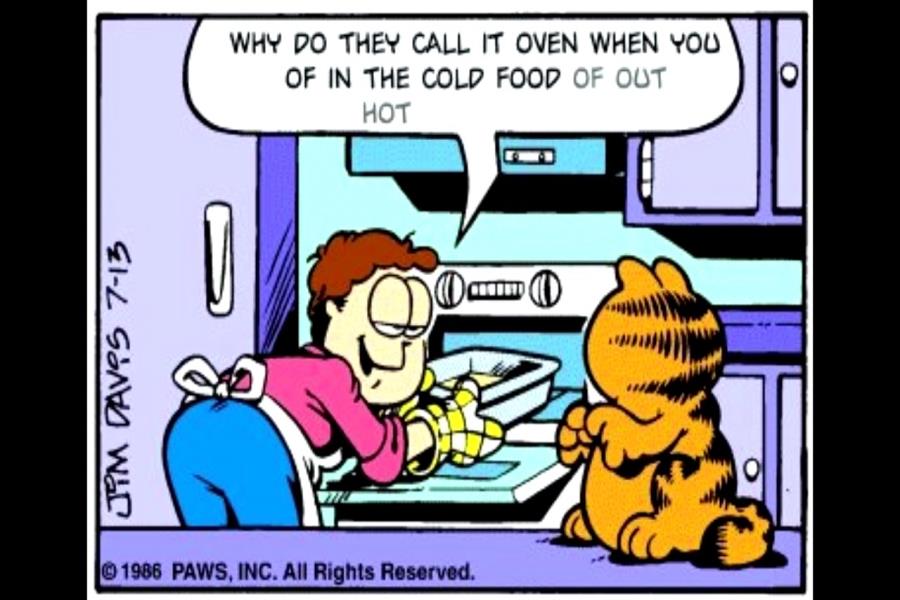
There’s a meme. It goes something like:
“Why do they call it oven, when you eat cold food or hot food?”
It makes no sense. It is in this sense that it is the best. The thing about the joke is that it’s supposed to make it look like someone is asking a logical question in English but goes off the deep end somewhere mid-sentence. It hit the ‘viral’ radar in 2014 and continues to reappear every few years.
However, the meme is wrong, but the question below is still valid. There are words in the English language that we use frequently and have no idea of their origin. For instance, ‘oven’ is a great example of that. You said that a thousand times! Knowing the origin of the word, did you know it was Old English? Probably not.
The meme led people unwittingly through some real linguistic history.
Why “Oven” Never Got Replaced
Most words evolve heavily over centuries. “Oven” basically didn’t. Ofen to ovene to oven. That’s the entire journey across a thousand years of English history.
A few reasons explain this kind of staying power.
The concept stayed the same. When the thing a word describes doesn’t change, the word usually doesn’t either. An oven in 900 AD was a hot enclosed cooking space. So is an oven in 2025. Same word. Done.
No strong competitor ever showed up. “Furnace” drifted toward industrial heating. “Kiln” became the word for pottery and brick firing. “Oven” had the kitchen entirely to itself.
It’s easy to say. Two syllables. Clean sounds. No awkward combinations. Languages tend to preserve words that don’t trip up the tongue.
It’s a survival word. Words connected to food, shelter, and daily necessity have always been the most stable in any language. “Oven” belongs to that category.

Every Type of Oven — Same Word, Completely Different Technology
Part of what makes the word so durable is how far it stretches. Look at how many different technologies have all kept the same name.
| Type of Oven | How It Works | Era |
| Wood-fired oven | Burning wood generates dry heat | Prehistoric |
| Stone oven | Heated stone radiates heat inward | Ancient |
| Coal and gas oven | Combustion heats the chamber | 1800s |
| Electric oven | Heating elements warm the interior air | Early 1900s |
| Convection oven | A fan circulates hot air for even cooking | Mid 1900s |
| Microwave oven | Microwave radiation heats food molecules | 1947 |
| Steam oven | Injects steam into the cooking chamber | 1990s (home use) |
| Smart oven | Sensor-based, app-controlled cooking | 2010s |
Eight completely different technologies. One word covers all of them. That’s not an accident — it’s proof that the word found the right level of abstraction and stayed there.
“Oven” Across Languages
The why do they call it oven question gets even more interesting when you look sideways at related languages.
| Language | Word for Oven | Root |
| Old English | ofen | Proto-Germanic |
| Modern English | oven | Old English |
| German | Ofen | Proto-Germanic |
| Dutch | oven | Proto-Germanic |
| Swedish | ugn | Proto-Germanic |
| Norwegian | ovn | Proto-Germanic |
| Danish | ovn | Proto-Germanic |
German still says Ofen. Dutch still says oven. Nearly identical to English. That’s because they all came from the same Proto-Germanic ancestor and none of them had a good enough reason to change.
Romance languages went a different direction entirely. French uses four, Spanish uses horno, Italian uses forno. All three descend from the Latin furnus. Same concept, completely different word family.
Two branches of the European language. Same hot box. Different names. Both are perfectly logical given their own histories.
Related Terms You Should Know
- why is it called an oven
- oven word origin
- etymology of kitchen words
- Old English cooking terms
- history of the word oven
Quick Answers
| Question | Short Answer |
| Why do they call it oven? | From Old English ofen, rooted in Proto-Germanic. It simply meant a heated enclosed space for cooking. |
| What does “oven” literally mean? | An enclosed chamber that uses dry heat to cook or bake food. |
| Is “oven” a borrowed word? | No. It developed within Germanic languages and entered English before the 11th century. |
| Why is it called a microwave oven? | Because it heats food inside an enclosed space using microwave radiation — technically making it a type of oven. |
| Who invented the word “oven”? | Nobody. It evolved naturally from Proto-Germanic into Old English over centuries of everyday use. |
| Why do people ask “why do they call it oven” online? | Partly a meme. But the actual question is a real one with a real linguistic answer. |
| Is the oven named after a person? | No. It’s a common noun with ancient roots, not named after any inventor. |
| What language did “oven” come from? | Proto-Germanic, through the root word uhwnaz, before becoming Old English ofen. |
What the Word “Oven” Actually Tells You About Language
Now here is what no other article will cover.
Why does the oven sound like an innocuous question. But on the surface, it is. It’s also a very small glimpse into the working of human language at its core.
Sometimes words do not come from noble backgrounds. A word may even have been created because a thing did exist, and people had to call it something. They chose sounds that worked! They passed down those sounds to their offspring. From them their children passed them further. Still after 1000 years the word remains and is still doing what it does, and always has done.
Oven was never all pretty AND glamorous. It was never rebranded. It has never been attributed to a great inventor. It continued to function. And languages like people tend to stick with what works.
The actual reason for them calling it an oven would be because of that.
Read Also: Why Does My Eye Hurt When I Blink? 8 Causes Most People Miss
So — Why Do They Call It Oven?
Ofen became oven and the word never ceased to be useful.
It dates back to Proto-Germanic. Passed through the English language. It outlived the Middle Ages, the Industrial Revolution, the invention of electricity and the microwave. It outlived all the technologies mentioned in it, and now it’s attached to objects which were unrecognizable to the original users of the word.
If someone asks, “Why do they call it oven?” (yes, they did find the meme or they really wanted to know) the response is the same. There was a need for a word. The word worked. It stayed.
Language in its best working order. No drama. No rebranding. A handy word serving a purpose for 1000 years and more.
FAQs:
Q1: Why do they call it oven?
The word “oven” comes from Old English ofen, which came from Proto-Germanic uhwnaz. It simply meant a heated enclosed space used for cooking. The word is over 1,000 years old and never needed replacing because the concept never changed.
Q2: What is the origin of the word oven?
The word traces back to Proto-Germanic uhwnaz, which evolved into Old English ofen, then Middle English ovene, and finally the modern word oven. German still uses Ofen and Dutch still uses oven — all from the same root.
Q3: Why do people ask “why do they call it an oven” online?
It became popular because of a viral meme that used broken English grammar for comedic effect. But the actual question has a real and interesting linguistic answer rooted in Old English and Proto-Germanic language history.
Q4: Is the oven named after a person or inventor?
No. Unlike many modern appliances, the oven was never named after its inventor. It is a common noun with ancient Germanic roots that developed naturally through everyday language over centuries.
Q5: Why is it called a microwave oven?
Because it heats food inside an enclosed chamber — which fits the definition of an oven. The “microwave” part refers to the type of radiation it uses. Since the basic concept matches, the word oven carried over.
Q6: What does the word “oven” literally mean?
It literally means an enclosed, heated chamber used for cooking or baking food using dry heat. That definition has not changed in over a thousand years of use.