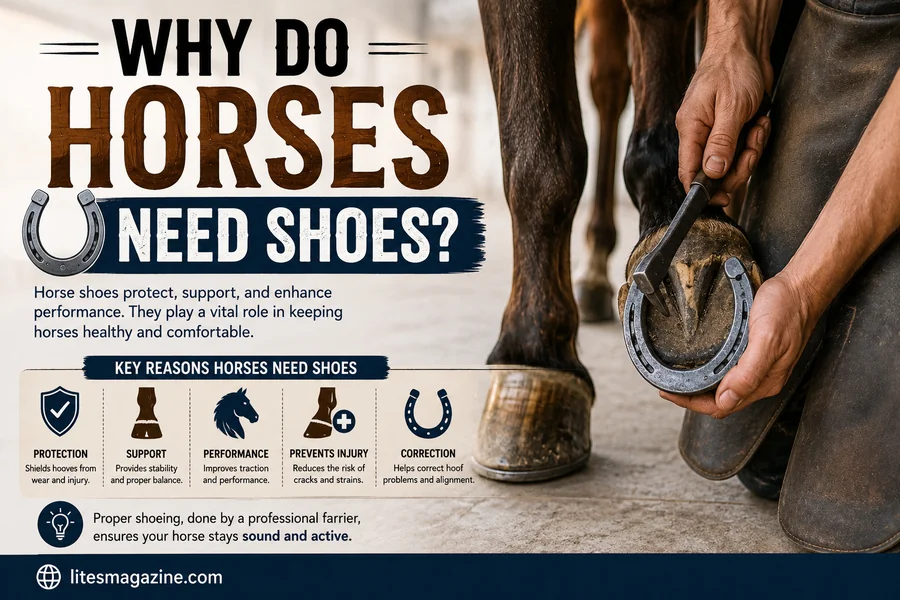
I get this question more than any other from people new to horses. Why do horses need shoes at all? Mustangs gallop across the Nevada ground barefoot, and nobody’s out there driving in metal! Fair point. There is one thing we need to remember and that is that we changed the job of the horse and we didn’t seek the hoof’s consent. Pavement, gravel, a 180 lb rider, a wet stall for 16 hours each day. That didn’t exist at the time of the evolution of hooves. Shoes are essentially a compromise between the hoove and what we want out of them.
However, many horses do not require them. Understanding your horse’s camp is more important than the shoe.
Why Do Horses Need Shoes? The Short Answer
Horses should be shod when their hooves become damaged through working, terrain or poor hoof structure that exceeds the rate of growth. Shoes are used to protect from grinding surfaces, to provide grip on slippery ground and for medical conditions such as laminitis. When wild horses roam around on natural ground, their feet toughen up and trim themselves, which is why they don’t wear shoes.
First, What a Horseshoe Actually Is
A horseshoe is a curved band of steel or aluminum fixed to the bottom rim of the hoof, usually with nails, sometimes glue. The hoof wall is keratin. Same stuff as your fingernails. Nail through the right spot and the horse feels about as much as you do during a manicure. Which is to say, nothing.
The catch is that the hoof never stops growing. Roughly a quarter inch a month, slower in winter. So a farrier comes out every four to six weeks, pulls the shoes, trims the new growth, and resets or replaces them. Skip that appointment a few times and the foot grows past the shoe, the angles go wrong, and tendons start paying the price.
Why Do Horses Need Shoes? The Five Real Reasons
1. The Ground We Put Them On
Asphalt and packed gravel sand a hoof down like a file. A horse doing road work or carriage pulling can wear hoof faster than it grows. Once wear wins that race, the horse goes lame. Steel between hoof and road slows the whole process down.
2. Grip
Watch a shod horse with studs cross wet pavement next to a barefoot one and the difference is obvious. Police horses, eventers, winter trail horses — they often get traction add-ons like borium or screw-in studs. Some get rubber pads. A slip at speed can end a career, the horse’s or the rider’s.
3. Fixing Problems
This is the part outsiders rarely see. Therapeutic shoeing is half the job for many farriers. Laminitis, navicular disease, thin soles, underrun heels, a hoof crack that won’t close. A vet takes radiographs, the farrier builds a shoe around what the X-ray shows. Bar shoes for heel support. Wedges to change the angle of the coffin bone. It’s closer to orthopedics than blacksmithing.
4. Our Weight, Not Theirs
A mustang carries a mustang. Your horse carries you, a saddle, maybe saddlebags, sometimes a cart behind it. Every extra pound lands on four feet that didn’t sign up for cargo duty.
5. Sport
Reining horses slide twenty feet on purpose. Barrel horses corner at angles that look physically illegal. Jumpers land half a ton on one front foot. Specialized shoes spread those forces around so the hoof survives the season.
Read More: Why Is My Cat Sneezing?
So Why Don’t Wild Horses Need Them?
Three reasons, and the last one is a bit grim.
Mustangs move 20 to 40 miles a day over rock, sand, and dry scrub. All that mileage wears the hoof evenly — a free trim, every day. The movement also pumps blood through the foot, which builds denser, tougher horns. Use it or lose it applies to hooves too.
The grim part: a wild horse with bad feet doesn’t last. It can’t keep up with the band, can’t escape predators, and that’s that. Nature culls poor hooves ruthlessly. Meanwhile we breed domestic horses for color, speed, or a nice temperament, and hoof quality quietly slides down the priority list. Some bloodlines today have feet their wild ancestors would be embarrassed by.
| Factor | Wild Horses | Domestic Horses |
| Terrain | Dry, abrasive, varied | Pavement, arenas, soft stalls |
| Daily movement | 20–40 miles | Often under 5 |
| Load | Just themselves | Rider, tack, cargo |
| Hoof genetics | Culled by nature | Bred for other traits |
| Moisture | Mostly dry | Wet bedding softens hooves |
Do All Horses Need Shoes? No — and Saying So Out Loud Starts Arguments
Walk into any tack room and mention barefoot trimming. Then pull up a chair, because you’ll be there a while.
The truth sits in the middle. Lots of horses do brilliantly without shoes. Good candidates usually tick most of these boxes:
- Work on pasture, sand, or other forgiving ground
- Born with thick walls and a well-shaped foot
- Trimmed on a regular four-to-eight-week cycle
- Light workload, light loads
- Live somewhere reasonably dry
Barefoot has genuine upsides. The hoof flexes with every stride, pumping blood through the foot — farriers call it the hoof mechanism — and a rigid metal shoe restricts that flex a little. The frog, that rubbery V on the underside, absorbs shock better when it actually touches the ground.
And if your barefoot horse only struggles on rocky trails? Hoof boots. Strap them on for the ride, pull them off after. Best of both worlds for a lot of weekend riders.
Does Nailing a Shoe On Hurt?
No. The nails pass through a dead, nerve-free hoof wall. Done right, the horse stands there half asleep.
Done wrong is another matter. A nail driven too far inward — a “hot nail” — finds live tissue and the horse will tell you about it immediately. This is exactly why a good farrier is worth waiting weeks for and a cheap one costs you more in vet bills than you saved.
How Often Does All This Happen?
| Situation | Typical Interval |
| Standard shoe reset | Every 4–6 weeks |
| Barefoot trim | Every 4–8 weeks |
| Therapeutic cases | Every 3–5 weeks |
| Winter (growth slows) | Every 6–8 weeks |
Often the old shoes go right back on. The metal outlives the trim cycle; it’s the hoof underneath that needs the attention.
Read More: Why Does My Cat Bite Me?
Shoe Types in Plain English
- Steel — the workhorse option. Cheap, tough, everywhere.
- Aluminum — light, favored at the track and in show rings.
- Bar shoes — closed loop at the heel for extra support during rehab.
- Rubber/composite — shock absorption for horses living on hard surfaces.
- Glue-ons — no nails, a lifesaver for shelly or cracked walls.
People Also Ask
| Question | Short Answer |
| Do horseshoes hurt horses? | No. Nails go through nerve-free hoof wall, like trimming a fingernail. A properly fitted shoe causes no pain. |
| Why don’t wild horses need shoes? | Daily travel over abrasive natural ground trims and toughens their hooves. They also carry no riders or cargo. |
| How long do horseshoes last? | The metal lasts months, but shoes come off every four to six weeks so the growing hoof gets trimmed. |
| Can horses go barefoot? | Yes. Horses with strong hooves, soft terrain, and light work often stay sound barefoot for life with regular trims. |
| What if a horse throws a shoe? | Restrict work on hard ground, protect the foot with a boot if possible, and call your farrier soon. |
| How much does shoeing cost? | Usually $80–$200 per visit depending on region. Corrective or glue-on work runs noticeably higher than standard steel. |
| Do horses mind being shod? | Most stand quietly. It’s painless, and a horse shod since youth treats it as routine as grooming. |
The Bottom Line
Why do horses need shoes? Because domestication rewrote the job description. Harder ground, heavier loads, less movement, softer feet from breeding choices. Shoes bridge that gap — for the horses that need the bridge. The rest do fine barefoot with a good trim schedule. Look at the horse in front of you, find a farrier you trust, and let the feet make the decision.
FAQs:
Why do horses need shoes but cows don’t?
Cows mostly stand around in fields. Working oxen actually did get shod historically — two-piece shoes, one for each half of the cloven hoof.
Did anything come before nailed shoes?
Romans strapped on “hipposandals,” a sort of metal-soled boot. Nailed shoes show up somewhere between 500 and 1000 AD as horses took on heavier work in wetter European climates.
Is barefoot better than shod?
Wrong question, honestly. The right question is what does this horse, on this ground, doing this job need. Your farrier and vet, looking at the actual feet, beat any internet opinion.
Does shoeing make a horse faster?
Racing plates are about protection at speed more than speed itself. A bruised foot loses every race.
What happens if you don’t shoe a horse?
It depends on the workload. Barefoot horses with strong hooves stay sound; hard-working horses risk hoof wear, bruising, and lameness.
Is it painful for horses to get shoes?
No. Nails pass through the nerve-free hoof wall, like trimming a fingernail. A properly fitted shoe causes no pain.
Read More Articles: Why Do Dogs Lick Their Paws?